
Honduras: Latin America's most underrated country is the region's biggest investment destination
By Próspera Team9 min read
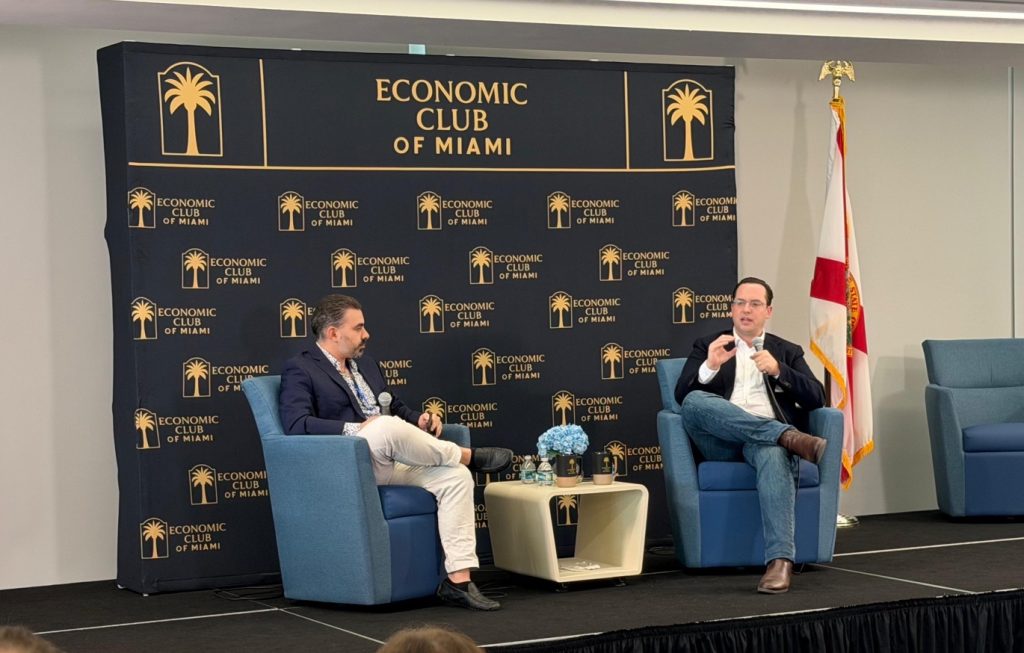
Erick Brimen, CEO of Honduras Próspera Inc., presents to the Economic Club of Miami the investment thesis that makes Honduras and Roatán the epicenter of a hemispheric economic revolution
On the stage of the Miami Economic Forum, organized by the Economic Club of Miami, Erick Brimen, CEO of Prospera and founder of Prospera Global He presented a compelling argument to an audience of investors and businesspeople from across the continent: Honduras is today, objectively, the country with the greatest investment potential in Latin America, and Roatán — home to the Prospera special economic zone (ZEDE) — its gateway.
“Honduras is perhaps the most underrated country that represents the best investment opportunity right now. The difference between perception discounts and the real value of assets surpasses all other economies in the region,” Brimen stated. With this premise as a starting point, the executive presented a geopolitical, economic, and institutional analysis that placed Honduras and Prospera at the center of the conversation about development in the Western Hemisphere.
The governance model: institutional innovation as a competitive advantage
If there is a common thread running through Erick Brimen's entire presentation to the Economic Club of Miami, it is this: the real obstacle to Latin America's development is not a lack of natural resources, capital, or human talent. It is governance. And Prospera has built its model precisely to address that layer.
“The most important thing an economy needs to flourish is not physical infrastructure: it the intangible infrastructure of governance“,” Brimen stated. Typical special economic zones, he explained, are limited to offering tax advantages or streamlining procedures through one-stop shops. The Prospera model goes further: it operates directly on how the institutional ecosystem is managed within the area ensuring that incoming capital finds stability, legal certainty, and conditions that transcend political cycles.
Regulatory reciprocity: the secret ingredient. One of the model's most distinctive innovations is what Brimen termed regulatory reciprocity. The idea is simple yet far-reaching: If a Texas company wants to set up a factory in Honduras, it shouldn't be forced to learn a completely different regulatory framework than the one it already knows. Prospera, as a governance platform, allows users to choose the applicable regulations, provided they select from the frameworks of OECD countries or approved jurisdictions. “That’s the secret ingredient for making these zones extremely compatible with capital from anywhere in the OECD world,” the CEO emphasized.
Arbitration as the standard, not the exception. Within the area, Arbitration is the default dispute resolution mechanism There is a framework agreement that states that, in the absence of an arbitration clause in a contract — or even in the absence of a contract — the Prospera platform's arbitration center acts as the default arbitrator. The times are radically different from those of ordinary justice. months, with a maximum of one year, compared to the ten years it can take to resolve a dispute in many countries in the region. “Many risks that hinder business growth arise when there is a dispute and it takes 10 years to resolve, or the outcome is not based on merit,” Brimen noted.
Regulatory insurance: aligning private incentives with regulatory compliance. Perhaps the The most sophisticated innovation of the model is regulatory insurance Instead of relying solely on a public regulator to oversee regulatory compliance, Companies operating in the area must contract a private insurer that covers their regulatory exposure If the framework is violated, not only does the company pay, but the insurer does too. This It creates a private actor with a direct financial incentive to ensure that the rules are followed., without over-regulating—because it would lose the client—or under-regulating—because it would absorb the loss. “The incentive to do it exactly right is internalized,” Brimen explained. “Ultimately, This works not only much more efficiently but more effective in ensuring that all actors are optimized for value creation.”
Governance as a service, replicable throughout the hemisphere. Brimen placed this model in a broader perspective: what Prospera has demonstrated is that institutional reform does not require transforming an entire country. It is enough to Deploy advanced special economic zones that share common law standards and good governance in any country that wants to adopt them“Each country, without needing to undergo national reforms, can deploy a framework that creates a standardized and highly attractive legal environment at the subnational level for U.S. and Western companies to invest, generating jobs and prosperity for the host countries.” Honduras was the pioneer. The ambition of Honduras Próspera Inc., part of Próspera Global, is for it to be the model for the hemisphere.
“Instead of trying to push through reform at the national level as the only option, what we are proposing and demonstrating is that a more surgical approach can be taken: standardization across the hemisphere without requiring national reforms.” — Erick Brimen, CEO of Honduras Próspera Inc.

LATAM: The best geopolitical tailwinds in history
To contextualize his argument, Brimen framed the historical moment the region is going through with a far-reaching comparison: Latin America today resembles China in the late 1960s and early 1970s, just before the greatest miracle of economic development in the last fifty years.
The similarities are structural, and the differences work in Latin America's favor: the region boasts a 70% urbanization rate, an economy far more open to international investment, and labor productivity already exceeding that of China at that time. Added to this is what Brimen called "perhaps the strongest geopolitical tailwinds in history": the revival of the Monroe Doctrine, the reconfiguration of global supply chains, and the active search for alternatives to Southeast Asia.
“LATAM as a continent is quite similar to what China was in the late 60s and early 70s. And where differences are seen, they tend to be very positive.” — Erick Brimen, CEO of Honduras Próspera Inc.
The challenge, he noted, is structural: Latin America is “substantially fragmented in terms of governance structures,” which prevents international capital from scaling up safely and predictably. This fragmentation is precisely the problem that Prospera has designed to solve.
Honduras: a confluence of still undervalued advantages
Within that Latin American context, Brimen focused his argument on Honduras with surgical precision. The country possesses a confluence of competitive advantages that remain undervalued by international investors:
- Nearshoring. Honduras is uniquely positioned in the region to capture the wave of industrial relocation that is redefining global supply chains. Its proximity to the United States, logistical connectivity, and labor costs create a combination that is hard to match. “Honduras could grow 50 times over through nearshoring alone, given its existing population and education levels,” Brimen stated.
- Human capital. The Honduran population combines high levels of bilingualism, especially in the northern corridor, with a solid university base. In La Ceiba alone, there are six universities that train hundreds of professionals annually who, due to a lack of local opportunities, emigrate. “Those people should stay home with good jobs,” he emphasized.
- Geopolitical alignment. Honduras is increasingly aligning itself with U.S. interests. “Honduras’s industrial base per capita, compared to, for example, Mexico, is negligible. That represents a huge opportunity for investment and socioeconomic development,” the CEO stated.
Roatán: the international hub of a new era
If Honduras is the most underestimated country in Latin America, Roatán is its most unique asset Brimen described the island as the ideal location to become the Caribbean equivalent of what Dubai It represents for the Middle East, or what it Hong Kong and Singapore They represent for Asia: a base of capital, talent and institutional infrastructure from which to project itself towards the rest of the country and the region.
The Direct connectivity with Miami —American Airlines operates daily flights— makes Roatán the only Caribbean destination with a vocation as a business hub that can be reached in a few hours from any city on the east coast of the United States.
La Ceiba and Puerto de Satuyé: the country's new industrial muscle
Alongside the Roatán hub, Honduras Próspera Inc. is developing a second strategic hub on the continent, within the Próspera ZED. And, the special jurisdiction: the Port of Satuyé, adjacent to La Ceiba, in the northern corridor. For Brimen, this project has the potential to reposition La Ceiba as the new industrial base of Honduras.
“La Ceiba was the industrial heartland of Honduras. Próspera isn't here to impose something different, but rather to revitalize and reactivate that past, which can become a better future,” he stated. The northern corridor, stretching from Atlántida to Trujillo, offers optimal conditions for growth of 20 to 30 times, taking advantage of the global nearshoring trend. Identified opportunities include agro-industrialization, BPOs, medical devices, and value-added wood products.
An industry that didn't exist: cutting-edge medical tourism
One of the most striking arguments of the intervention was the i Roatán's emergence as a high-value medical tourism destination Thanks to Prospera's regulatory reciprocity framework, the island now attracts longevity therapies, advanced gene therapies, and regenerative medicine that don't find a place in other jurisdictions. "I'm not talking about cheap hair transplants." I'm talking about advanced gene therapies, stem cell therapies, longevity therapies“,” Brimen explained.
Institutional stability: beyond political cycles
Compared to other reform initiatives in the region, Brimen pointed out their main weakness: they depend on political cycles“Any major investment that will truly lift people up needs more than four to eight years of stability.” The model of advanced special economic zones solves this problem by enclosing favorable conditions in legal stability agreements and even international treaties. As proof, he pointed out that even during the four most difficult years of the Honduran political context, the Prospera territory continued to receive massive inflows of long-term capital.
Honduras in 20 years: an industrialized nation in the heart of the hemisphere
Brimen concluded with a vision for the future: if the model scales up, in two decades the hemisphere will be much more integrated, the major current problems —migration, crime, trafficking— will have given way to a debate on economic specialization, and Honduras will occupy a central place in it. “I see Honduras becoming a much more industrialized nation. You would go from cutting things by hand to having engineers maintaining robotic arms and advanced machinery.”.
In Erick Brimen's view, Honduras is not just another emerging market. It is the place where the future of economic development in the Western Hemisphere is being shaped. And Próspera is the platform from which this new governance model is taking shape in Roatán.